48 Hours at Sea, Two Boards, and 18,000 Reasons Not to Give Up
Arnu Rausi will paddle Malta's coast for 48 hours by SUP and kayak, 13–15 November, raising funds for UNICEF's work with children in war zones.
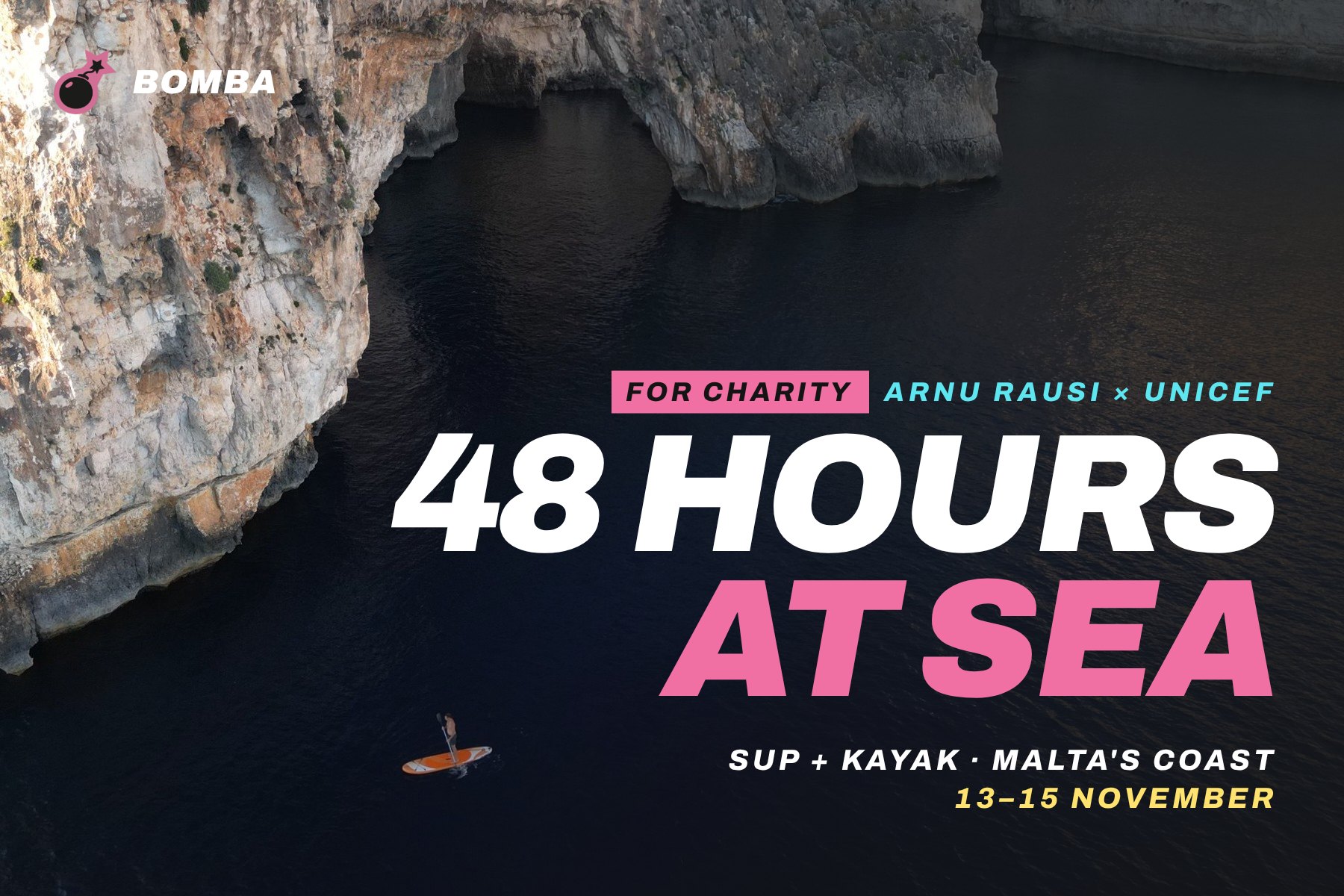
Half-Maltese, half-English adventurer Arnu Rausi is preparing to spend 48 hours on Malta's waters to raise funds for UNICEF. Behind the extraordinary challenge lies a deeply personal reason for refusing to sit still.
There is a point, somewhere in the middle of the night, when the Mediterranean stops looking like the postcard sold to tourists.
The coastline disappears into darkness. The wind picks up. Your arms are exhausted, your mind starts playing tricks, and every unfamiliar sound in the water becomes something worth worrying about.
Most people would rather be in bed.
Arnu Rausi is voluntarily heading straight into it.
At 5pm on Friday, 13 November, the half-Maltese, half-English adventurer will begin a 48-hour endurance challenge, alternating between a stand-up paddleboard and a kayak along Malta's coastline.
If everything goes to plan, he will finish at 5pm on Sunday, 15 November, having spent two days and two nights confronting the Mediterranean, physical exhaustion and his own mind.
He knows what could go wrong. Strong currents, violent weather, seasickness, exhaustion. He even lists drowning among his fears.
💣 Support Arnu's 48-hour challenge for UNICEF
From 5pm on Friday 13 November to 5pm on Sunday 15 November.
DONATE TO ARNU'S FUNDRAISER →
Yet none of those possibilities frightens him quite as much as doing nothing.
"The worst thing that can happen is being carried out to sea," Rausi tells BOMBA. "But worst of all, watching these atrocities happen and feeling incapable of doing anything positive about it."
And that, rather than some obsession with breaking records or collecting Instagram applause, is where this story really begins.
The 18,000 Names That Changed Everything
For 17 years, Rausi has taught English and literature across almost every continent, with Antarctica the only exception.
Teaching has taken him around the world, exposing him to different cultures, different lives, and the one thing he believes should never depend on where someone happens to be born: a child's right to education, protection and safety.
He even created Avatar English, a platform providing free interactive English education.
Yet increasingly, the world's news has left him questioning whether any of it is enough.
With close Palestinian and Ukrainian friends, the wars affecting their communities are far more personal than distant headlines.
Then came a television report from New York.
Rausi describes seeing a memorial called the Wall of Tears, displaying what he understood to be 18,000 names of Palestinian children killed in the conflict.
Something snapped.
"I couldn't sit down and do nothing any more. I got tired of complaining. Moaning. Doing nothing."
Those names represented children who had families, ambitions, friendships and entire futures ahead of them.
"Just like me and you, they wanted to grow up and be someone. That privilege was robbed from them."
He began researching humanitarian organisations before settling on UNICEF, whose work supporting vulnerable children through education, nutrition, clean water and emergency assistance aligned with his purpose.
The question was how to make people pay attention.
His answer was to put himself somewhere deeply uncomfortable.
Four Days Without Food or Water
This isn't Rausi's first encounter with extreme physical and psychological hardship.
During his travels in Mexico, he participated in Sundance and vision quest experiences, including four days without food or water.
The hunger, surprisingly, wasn't the worst part.
"After two days the hunger got easier to deal with. But the thirst on the third day and fourth led to anxiety attacks and dizziness."
Then came the nights.
Heavy rain. Cold winds. Sleeplessness. Thoughts he could no longer distract himself from.
It was a brutal experience, one that he credits with forcing him to confront fears he had carried for years.
"While these were by far the darkest hours, they were also the moments that brought my greatest release from lifelong fears that I had failed to confront."
Now he wants to revisit that psychological territory, this time surrounded by water.
He is careful not to equate a voluntary endurance challenge with the suffering of children trapped in war zones.
"It's nowhere near the same, but it's the closest I can get here in Malta."
For him, the challenge is a symbolic attempt to confront vulnerability while directing attention towards people who have no choice about the conditions they endure.
And while the physical demands will be considerable, he suspects his greatest opponent might not be the Mediterranean at all.
It might be his own head.
The Darkness Is Where Things Get Interesting
Anyone who has spent enough time in the sea knows how quickly conditions can change.
A pleasant afternoon paddle can become a miserable battle against the wind. A current barely noticeable from shore can turn every metre into hard work.
Now imagine dealing with that after more than 30 hours of physical effort and disrupted sleep.
Rausi's plan is to paddle through the night when conditions permit, resting during daylight hours while friends monitor his progress from the coastline.
"For my safety, I will sleep during the day, where I can be observed by friends who will be walking along the coast and accompanying me."
If the weather deteriorates, he has considered sheltering in a coastal cave, although this would bring its own safety risks.
He has no illusions about what might happen.
"The biggest challenge will be the nights."
Yet there is something almost contradictory about his relationship with fear. He is actively seeking the silence that most people spend their lives trying to escape.
"Without a doubt, the 'nothing' is what I crave the most on these 48 hours. The silence. The lack of support, comfort, or habit, so I can delve deeper into my own mind and grow beyond my self constructed mental boundaries."
For someone accustomed to travelling, teaching, meeting people and constantly moving, the absence of distraction is its own form of endurance.
There will be no classroom to occupy his attention. No familiar routine.
Just the sound of water against the board, the occasional paddle stroke, and whatever thoughts turn up when the rest of the world goes quiet.
Malta, From an Entirely Different Perspective
There is another reason Rausi chose the sea.
He has fallen in love with stand-up paddleboarding.
Not for competition, speed or distance, but for the simple pleasure of discovering the island from a perspective most people never experience.
"It's become my new meditation. My escape and discovery of living in Malta. Whoever says Malta is small, simply doesn't spend enough time in the beautiful sea surrounding us."
His dream is for calm conditions that allow him to showcase the island's less explored coastline, particularly the dramatic western cliffs around Ħaġar Qim and Mnajdra.
It's an extraordinary stretch of the Mediterranean, with towering limestone cliffs, hidden inlets and long sections of coastline that feel a world away from the country's crowded beaches.
Beautiful, certainly.
Forgiving? Not necessarily.
Exposed coastal waters, changing winds and the challenges of paddling in darkness make this a serious undertaking. A support and emergency plan will be essential, particularly if conditions deteriorate.
Still, he hopes the journey might remind people of the remarkable natural environment sitting right on their doorstep.
"The dream scenario is having great days of weather and being able to show sides of Malta that people don't get exposed to. Mainly the west coast around Hagar Qim and Imnajdra. This area has been my heaven on the rock, and I'd love people to see this less explored side."
The Friend Who Cannot Speak Freely
Behind the physical challenge lies a friendship that has given the fundraiser an especially personal meaning.
One of Rausi's closest friends in Malta is Palestinian. They meet every week.
He describes a man trying to remain positive despite the suffering affecting his people, someone who wants to speak out but fears that public activism could expose his family back home to danger.
"His bravery and courage to stay strong and happy in these horrific times goes beyond my understanding of life."
His friend wants to help. He wants to honour those who have died. Yet he fears the consequences for those he loves.
"How tragic that a human can't honour the dead or help those in desperate need in fear of bringing more harm."
It is a reality that has stayed with Rausi.
He recognises that he has the freedom to raise awareness publicly, organise a fundraiser and speak about the conflict without facing the same personal risks.
"Fortunately for me, I'm not in that situation and I can use social media to raise awareness and raise funds to help those in need."
The challenge, then, isn't simply about surviving two nights at sea.
It's about using the freedom he has to help people whose choices have been severely restricted.
What Happens When the Paddling Stops?
There will be a moment, assuming everything goes to plan, when Rausi finally steps off his board at 5pm on Sunday, 15 November.
His arms will ache. His body will demand sleep. He will probably have had enough of looking at water for a while.
Whether he finds the personal transformation he is searching for remains to be seen.
Whether the fundraiser succeeds will depend on the people watching from dry land.
He hopes the challenge encourages donations, conversations and a greater awareness of what children living through conflict face every day.
"Raising as much money as possible and getting people to become more aware of what children in warzones face on a daily basis are my main goals."
For anyone considering their own challenge, he offers a piece of advice shaped by years of travelling and testing his limits.
"You will only discover who you truly are when you place yourself in situations that far surpass your levels of comfort. And when you discover what that is, do it for a cause bigger than yourself. You'll always achieve more when others are depending on you."
It's worth remembering that Rausi can end his ordeal. He can return to shore, eat a proper meal, sleep in a warm bed and recover.
Millions of children living through war and displacement cannot simply paddle away from their circumstances.
That difference is the entire point.
Forty-eight hours of discomfort won't end a war. It won't bring back a single child. But if it can help protect those still living through one, Rausi believes it's worth every stroke.
Support Arnu's 48-Hour Challenge
From 13 November at 5pm until 15 November at 5pm, Arnu Rausi will take to Malta's waters to raise awareness and funds for UNICEF's work supporting vulnerable children.
Every donation, however small, can contribute to providing essential assistance to children facing unimaginable hardship.
You can also learn more about UNICEF's humanitarian work or donate directly to UNICEF.
Follow Arnu's journey, share his story and help turn 48 hours of endurance into something that lasts far longer.