The Highs and Lows of a Loved Surf Brand: Quiksilver (and How We Still Love It)
· 10 min read
Founder / Head-First Department
Mark doesn't wait around. If there's a wave, an idea, or a bad decision to be made, he's already in it.
From a Torquay garage in 1969 to a $2.43B peak, Kelly Slater, Rossignol, Chapter 11 and the loss of Pierre Agnès: the full Quiksilver story.
Surf culture history
A pair of boardshorts sewn in a Torquay rental became a billion-dollar company on the New York Stock Exchange. Then it went bankrupt. Somewhere in between it bankrolled Kelly Slater's 11 world titles, invented the modern big-wave contest and turned a sleepy French beach town into Europe's surf capital.
Quiksilver is the story of surfing's industry in one logo: the mountain and the wave. Massive highs, brutal lows, a few tragedies, and one brand most of us still pull on before a paddle-out. Here's the whole ride.
1969: Two mates, a garage and a better boardshort
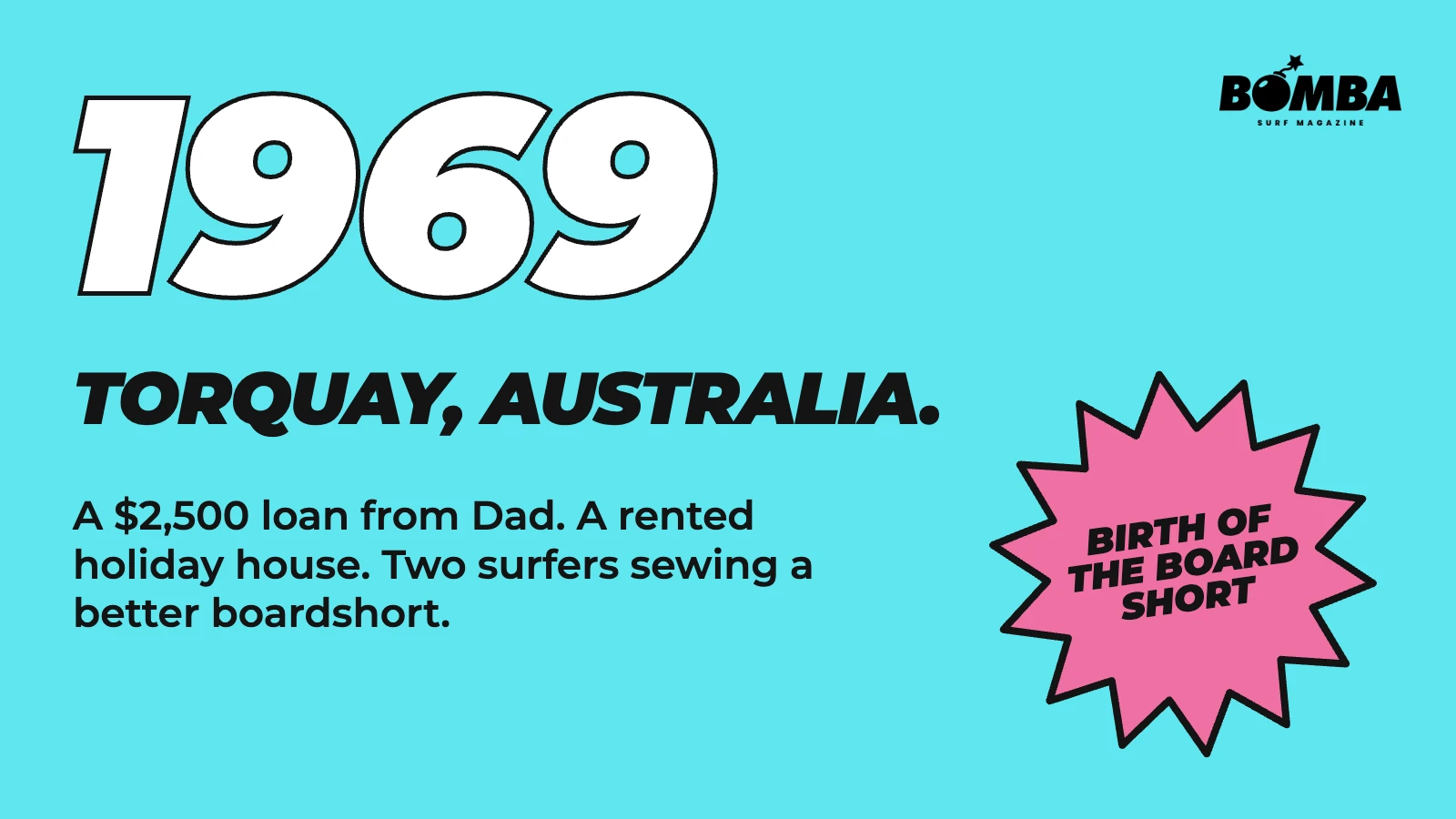
It starts in Torquay, Victoria, the cold-water town that also gave us Rip Curl. In 1968 Alan "Greeny" Green was helping Doug "Claw" Warbrick and Brian Singer get Rip Curl's wetsuits off the ground. A year later, aged 22, he borrowed $2,500 from his father and started experimenting with boardshorts out of a small rented holiday house.
Green soon partnered with Victorian surfing champion John Law. The shorts were sewn in living rooms and garages around Torquay, a literal cottage industry. The design was the point: cut for surfing, not for lying on the beach.
The logo came early. Inspired by Hokusai's woodcut The Great Wave off Kanagawa, it shows a big wave with a mountain on a red background, designed in 1973. By 1975 the shorts were sold all over Australia.
1976–1984: A drunken pitch at Bells, then the world
The jump overseas was pure surfer logic. In 1976 Hawaii's Jeff Hakman, "Mr Sunset", won Bells and left Torquay with a trophy and a deal to sell Quiksilver in America. Green later remembered it as "some drunken proposition".
Hakman's partner was Bob McKnight, who first thought the shorts looked like "some stupid pair of swim trunks". He changed his mind fast. The pair started Quiksilver USA in Newport Beach, and McKnight would steer the American company for nearly four decades.
In 1984 Hakman went again, this time to France with Harry Hodge, Brigitte Darrigrand and John Winship, who won the licence for all of Europe. Based on the Basque coast, Quiksilver Europe found that surfwear alone couldn't survive eight months of winter. So it took the mountain and wave to the mountains, building a snow line with adventurer Jean Afanassieff.
That same year Quiksilver also created a legend in Hawaii: the first "Quiksilver in Memory of Eddie Aikau" big-wave contest, held at Sunset Beach. The Eddie became the most respected event in surfing, the one that only runs when Waimea is truly huge.
1986–2005: Wall Street, Roxy and the billion-dollar wave
Quiksilver became one of the first surf companies to go public, listing in 1986. The money bought ambition. In 1988 two-time world champ Tom Carroll signed surfing's first million-dollar contract, and the industry's first exclusive head-to-toe deal.
Then came the moves that defined the 90s:
1990: Roxy launches, the women's brand built around Lisa Andersen and a crew of young female surfers.
1991: Quiksilver Inc. buys Quiksilver Europe and starts becoming one global company.
1993: The Roxy heart logo arrives, two mountain-and-wave logos mirrored into a heart.
1995: The first Quiksilver Pro runs at G-Land, Indonesia.
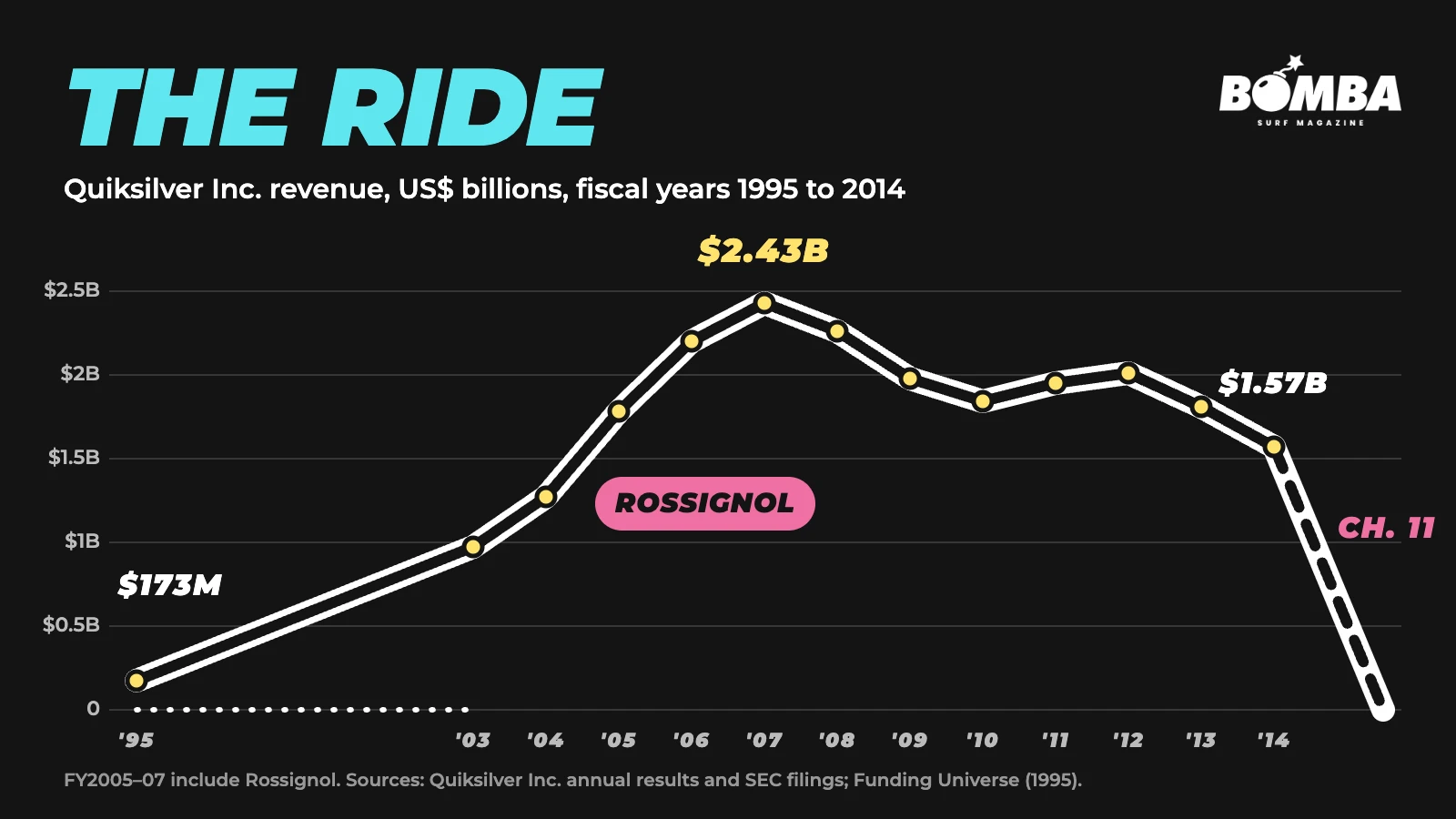
Sales hit $172.7 million in 1995. Then the early 2000s turned surf into mall fashion. After Blue Crush, everyone wanted to dress like a surfer.
In May 2004 Quiksilver bought Ken Block and Damon Way's DC Shoes for about $88 million in cash and stock. That year revenue passed $1 billion for the first time, up nearly 30% to $1.27 billion. Roxy alone was about a third of sales.
Inside, staff called the glass HQ in Huntington Beach "The Death Star". By early 2005 the company was worth around $2 billion, and the mid-2000s were all trips, tours and expense accounts. Massive.
1990–2014: The Kelly Slater years
In 1990 Bob McKnight signed an 18-year-old from Cocoa Beach, Florida. Right after, Slater won the $100,000 Body Glove Surfbout at Lower Trestles and put everyone on notice. His first world title came two years later, aged 20.
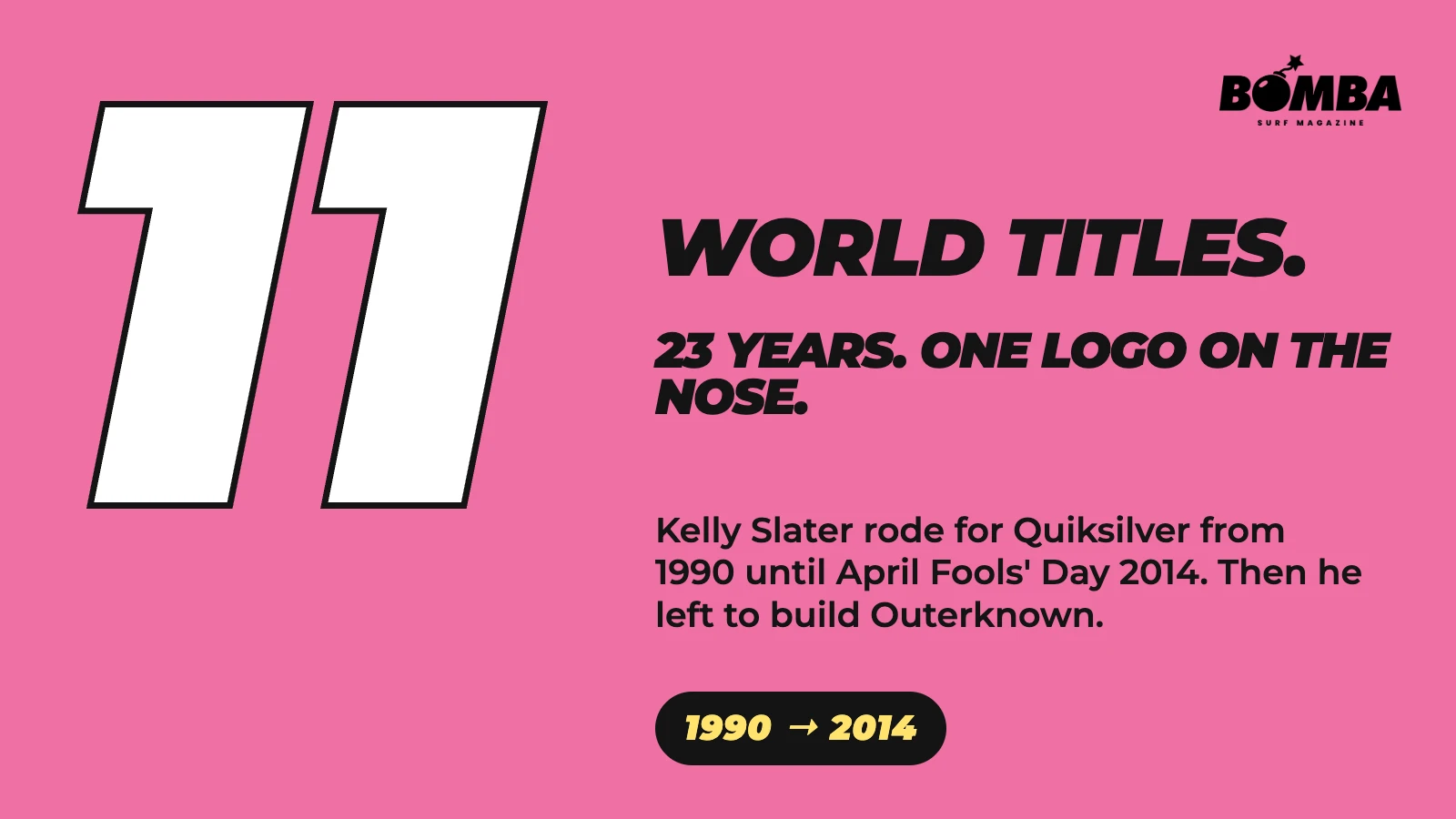
What followed is the greatest run in competitive surfing. Slater won 54 events and 11 world titles, the last in 2011, all with the mountain and wave on his nose. To a generation, Kelly was Quiksilver. His 2009 renewal was reportedly worth about $400,000 a year before royalties and bonuses.
He wasn't alone. The Quik team over the years read like a hall of fame: Tom Carroll, Lisa Andersen for Roxy, a young Jack Johnson in 1987, and later Dane Reynolds, Jeremy Flores and Mikey Wright.
The end came on April Fools' Day 2014, which made the news hard to believe. In a long letter, Slater ended the 23-year partnership and moved to a new brand backed by luxury group Kering. His Quik label VSTR had already been killed in the cutbacks. The new brand, Outerknown, launched in 2015. One surf mag compared it to Michael Jordan leaving Nike.
2005–2014: The Rossignol wipeout
The fall started with one deal. In July 2005, led by president Bernard Mariette, Quiksilver bought French ski giant Rossignol. Counting debt, the price was about $560 million, and Quik then poured roughly $300 million more into it, including a new factory in France. Analysts had warned against it.
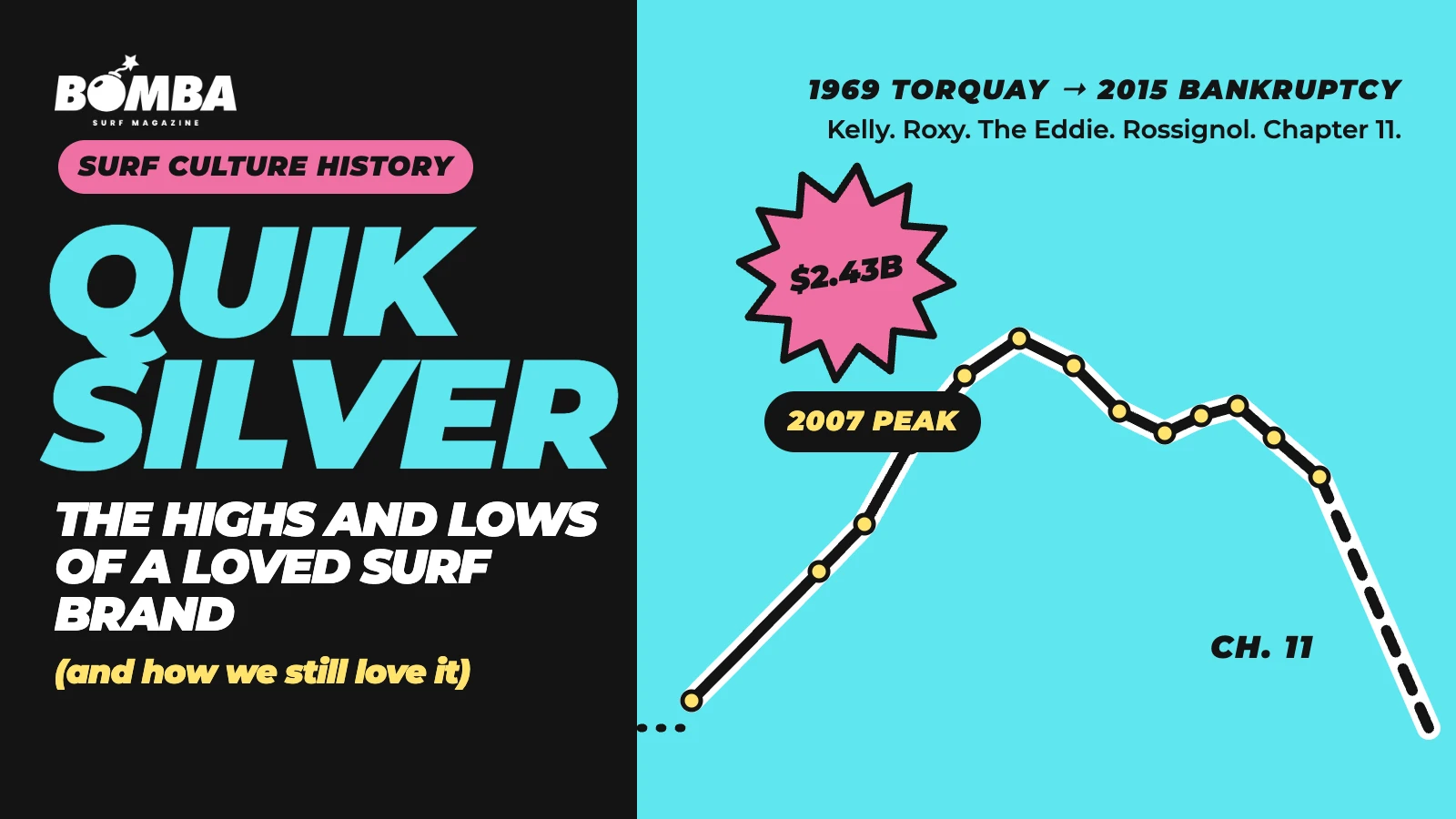
For a while the top line looked heroic. Revenue hit $2.43 billion in fiscal 2007, and the company was valued at around $1.66 billion. Shares traded around $12–13.
Then the snow didn't come. McKnight later said Europe had "the worst winter in like five decades" right as they were set to go. A sale was lined up for the week of 15 September 2008, the week Lehman Brothers collapsed. The offer fell from €110 million to €40 million overnight. Rossignol went for about $50 million, under 10% of what Quik paid, and McKnight publicly called the deal a mistake.
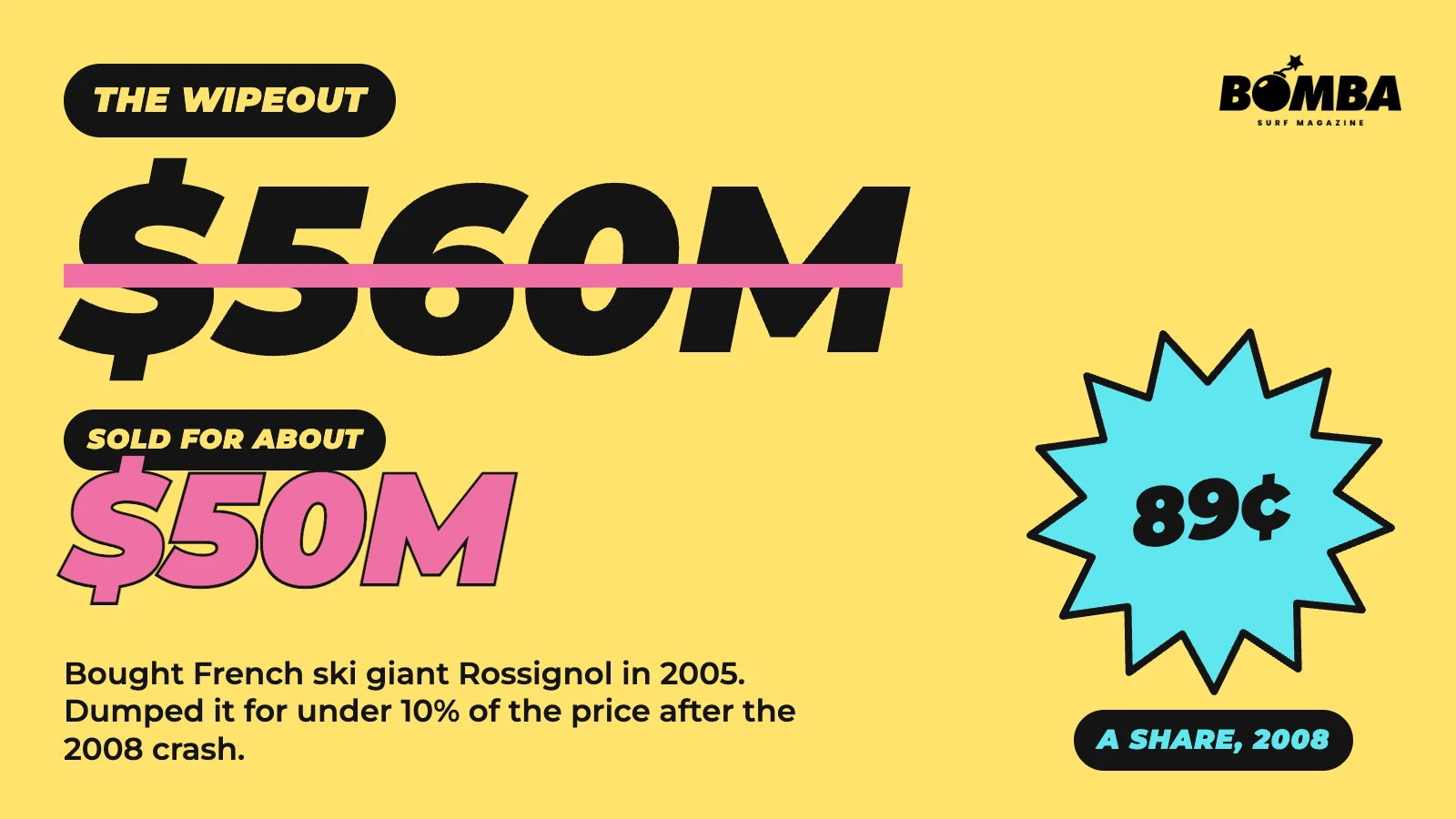
It left Quiksilver with about $1 billion of debt. Right after the crash, ZQK stock traded at 89 cents. In 2009 a lifeline loan from France's Rhône Group came at 15% interest, plus the right to buy a fifth of the company. Shares fell 35% in a week.
The brands kept selling, but the rest of the world changed: fast fashion, online shopping, kids avoiding big logos. In 2013 ex-Disney Consumer Products chairman Andy Mooney took over as CEO. Core surf shops backed away from the brand under his push into wider distribution. Losses grew from $239 million in fiscal 2013 to $327 million in fiscal 2014.
2015: Bankruptcy
The wipeout was complete by September 2015. Mooney had left in March after a delayed earnings report blamed on a "revenue cut-off issue". On 9 September 2015, Quiksilver Inc. and ten US subsidiaries filed for Chapter 11 in Delaware, with more than $800 million of debt.
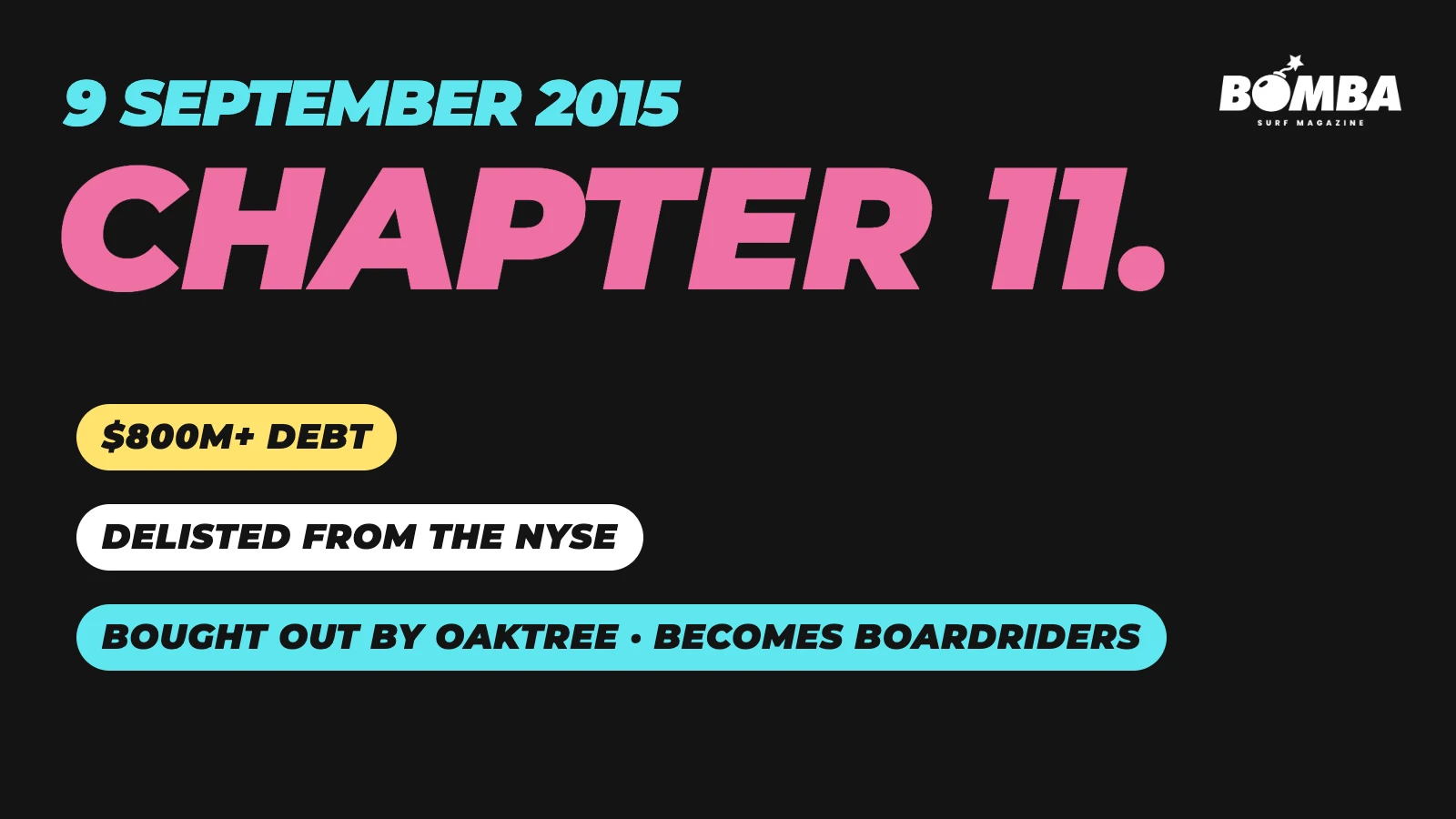
The same day the New York Stock Exchange suspended ZQK and started delisting it. The company had lost around 80% of its market value in a few years. Chairman Bob McKnight's 3.3 million shares were set to be wiped out.
Only the US business went under. Europe and Asia-Pacific, more than half of sales, stayed out of the filing. Private-equity firm Oaktree Capital put up $175 million to keep the lights on and swapped its debt for control. Quiksilver came out of bankruptcy in February 2016 as a private company owned by Oaktree, later renamed Boardriders.
Pierre Agnès: the surfer who saved it, and the sea that took him
If one person carried Quiksilver through the dark years, it was Pierre Agnès. Born in Capbreton, he captained the French surf team in the 80s and surfed at the 1984 Los Angeles Olympics, when surfing was a demonstration sport. He joined Quiksilver as French team manager and was soon put in charge of the first Quiksilver store in Biarritz.
Over nearly 30 years he climbed the ladder, running design for the brands from the European HQ in Saint-Jean-de-Luz. In March 2015, with the company in freefall, the board made him CEO in place of Andy Mooney. He steered it through Chapter 11 and the Oaktree takeover, and stayed the group's link to real surfing. By early 2018 he was leading the bid to buy old rival Billabong.
On 30 January 2018 he did what he did most mornings. He left Capbreton alone at 7:30am to fish aboard his 11-metre boat Mascaret III. He radioed the port that thick fog would delay his return. At 9:15am the boat was found upside down and empty, washed up on the beach at Hossegor near La Gravière.
Helicopters and boats searched for two days before the coastguard called it off. On 2 February Boardriders confirmed he was lost at sea. He was 54, a father of three. Surf stars and a packed Capbreton church said goodbye on 9 February. The man who rescued Quiksilver from the money men was taken by the ocean that made him.
2018–2025: Quikbong, new owners, more closures
The Billabong deal Agnès started went through. In 2018 Oaktree's Boardriders bought struggling Billabong and RVCA for around $250 million. The two great Australian rivals of the 70s ended up under one roof. Billabong's team even left its Hossegor HQ to move into Boardriders' buildings in Saint-Jean-de-Luz.
In 2023 Oaktree sold the lot to Authentic Brands Group, the brand-licensing giant behind Reebok, for more than $1.25 billion. Authentic doesn't run shops or sew shorts. It owns the logos and licenses them out to operators.
In the US that operator was Liberated Brands, and it lasted little more than a year. In February 2025 Liberated filed for bankruptcy, closed all 120-plus Quiksilver, Billabong and Volcom stores in the US and laid off nearly 1,400 people. Authentic moved the licences to new partners, and the clothes kept selling through surf shops, department stores and online.
A month earlier, on 14 January 2025, Alan "Greeny" Green died at home in Torquay, aged 77. "Love you, Greeny," Kelly Slater wrote.
Why we still love it
Strip away the share price and the private equity and you're left with what Greeny and John Law were making in 1969: a better pair of boardshorts for people who actually surf. That part never really went bankrupt.
Quiksilver gave us the Eddie. It put Hossegor on the world map and ran the tour stops we grew up watching, from G-Land to Snapper to La Gravière. It paid Kelly to become Kelly and Roxy to show a generation of girls the lineup was theirs too. Even in the worst years, the mountain and wave on a nose meant someone was getting barrelled somewhere.
The lesson for every surf brand, ours included, is easy to say and hard to live: stay close to the water. Quik was massive when it was surfers making things for surfers, and it drowned when it tried to be a ski company, a mall brand and a stock-market darling all at once.
So next time you pull on an old pair of Quik boardies before a dawny, give a nod to Greeny, to Pierre, and to every soggy-handed surfer who built that logo. Rough ride, still the best wave in the logo game.
Timeline at a glance
1969: Alan Green and John Law start making boardshorts in Torquay
1973: Mountain and wave logo
1976: Hakman wins Bells, starts Quiksilver USA with McKnight
1984: Quiksilver Europe founded; first Eddie Aikau event
1986: Goes public in the US
1988: Tom Carroll's $1M deal, surfing's first
1990: Roxy launches; Kelly Slater signs
1995: First Quiksilver Pro at G-Land
2002: Quiksilver Pro France starts in Hossegor
2004: Buys DC Shoes; revenue passes $1B
2005: Buys Rossignol, ~$560M including debt
2007: Peak revenue, $2.43B
2008: Rossignol dumped for ~$50M; stock hits 89 cents
2014: Kelly Slater leaves after 23 years
2015: Pierre Agnès named CEO; US Chapter 11 and NYSE delisting
2016: Exits bankruptcy as a private Oaktree company
2018: Agnès lost at sea off Hossegor; Boardriders buys Billabong
2023: Authentic Brands Group buys Boardriders for $1.25B+
2025: Alan Green dies; all US stores close
Sources